Understand the window without inventing a passing score
The official feature description connects automatic wider sharing to Instagram's assessment of views received during the first 72 hours. It does not publish a universal passing number in that explanation. You therefore cannot turn the window into a rule that every creator needs the same view count, or that a particular count guarantees release.
Keep the timing statement and the performance condition together. Removing the condition changes the meaning. A calendar reminder can help you review a trial, but a reminder is your workflow choice, not evidence that the platform must perform an action at that exact moment.
It is useful to write down what you expect before publication. Are you comfortable allowing an automatic wider release if the feature's condition is met? Or do you want to review the content yourself before expanding its audience? Answer that question in ordinary language before navigating the controls. It makes an ambiguous setting easier to recognize rather than something to guess through.
Do not borrow a passing score from another account's screenshot. Without a verified rule that applies to your account, it remains an account observation or an unsupported interpretation. No minimum-view target, success percentage, or forecast of automatic release frequency is established here.
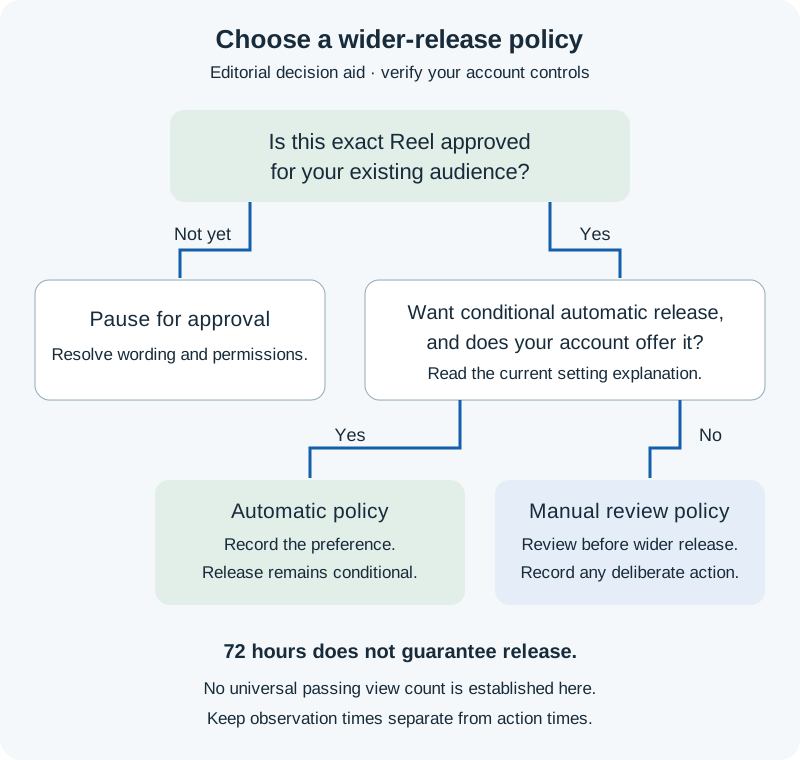
Choose a release policy before choosing an interface option
A practical editorial distinction is permission to release versus an obligation to release. An automatic setting can express your permission for the feature to act under its conditions. It should not replace your own content approval. If you would still need a client, collaborator, or brand manager to approve the Reel, complete that review first.
For a hypothetical campaign, imagine a creator is trying an unfamiliar explanation of a product. The team is happy for that exact wording to reach its existing audience. Automatic release may fit that editorial intention if the account offers the relevant setting. Now imagine the wording is still awaiting approval. The trial stage does not resolve the approval issue, so the publishing plan needs attention before any release choice.
This is a decision framework, not a claim that a particular account has a working toggle. The account-specific interface still needs verification. If the labels differ from a tutorial, read the accompanying explanation and use what your account actually displays. Do not map an unfamiliar switch to a remembered option simply because both mention sharing.
Keep a record of your intention independently of the interface. “Review personally before wider release” is a useful note even when the app wording changes. “I clicked the usual thing” is much harder to audit when a teammate later asks what was authorized.
For the broader publishing sequence, use how to use Instagram Trial Reels.
Document automatic and manual actions separately
Automatic sharing and creator-initiated wider sharing are distinct release choices. That does not mean every observed release can be attributed to the automatic option. Your own actions and a teammate's actions belong in the same event record before you decide what caused a state change.
Use a short publishing log with fields for the Reel identifier, publication time, intended release policy, setting as observed, and later actions. Add a separate field for the time you first observed the wider-sharing state. Label that last field carefully: an observation time is not necessarily the exact transition time.
If someone manually shares the Reel more widely, record that event rather than leaving the outcome under an “automatic” heading. If nobody can establish who acted, write “release route unconfirmed.” That is more accurate than assuming the feature made the decision because an early-performance window had passed.
A suggested event record could read:
- Intended policy: personal review before wider release.
- Setting observed before publishing: transcribed from the account.
- Later action: creator initiated wider sharing, with a recorded time.
- State checked afterwards: transcribed from the account.
- Any missing evidence: identified rather than reconstructed.
This template is editorial documentation. It is not a required platform form, a claim about available audit logs, or a walkthrough tested on your account. Replace blank fields with observations, not with plausible-looking interface text.
If your question is what happens after release, read whether sharing a Trial Reel changes its momentum. That separate guide addresses observed outcomes rather than the release setting.
Keep your review decision distinct from Instagram's assessment
An automatic performance decision and your editorial decision need not answer the same question. You may care whether the Reel explains the right idea, makes an accurate claim, or fits a campaign. A view-based assessment does not supply your missing approval on those matters.
Before reading results, write the decision you are trying to make. For instance, a hypothetical educational creator might ask whether the opening communicates the lesson without prior context. The creator's review note could focus on the questions people ask and any misunderstanding visible in the responses. That is a chosen evaluation method, not a claim about Instagram's undisclosed passing criteria.
When you save performance readings, keep the original metric names and the time of capture. Avoid presenting a later reading as the exact value used by an earlier automatic decision. If you did not observe the decision time or the underlying assessment, mark those details unknown.
Also separate a publishing outcome from a recommendation about quality. A Reel that remains in trial has a publishing state you can inspect. It does not, by itself, establish a universal verdict on the content or explain every factor behind distribution. Your next editorial action can still be specific: revise the explanation, retain the existing version for review, or make a deliberate wider-release decision using the available controls.
Investigate an unexpected outcome with a bounded record
If you expected automatic sharing and cannot confirm it happened, begin with the account's present state. Identify the exact Reel and compare it with your original intention. Then inspect any relevant sharing preference that is actually available to you. Do not assume an option was enabled merely because you used it on a previous post.
Save the facts you can establish: the Reel, your observation times, the visible state, the current option wording, and any deliberate action. Keep screenshots limited to relevant information. Avoid exposing account credentials, private messages, or unrelated client details when discussing the problem with another person.
If the record is incomplete, describe the incomplete part. You may know when you published but not when the setting was changed. You may see a wider-sharing state without knowing which action produced it. These are different uncertainties, and neither is repaired by writing that the algorithm “must have” done something.
There is no verified one-button remedy supplied here. Repeatedly changing settings to force an outcome would also make your own event history harder to interpret. A more useful next step is to preserve the current evidence, decide whether a manual release serves your goal, and consult the account's current guidance before taking an unfamiliar action.
FAQ
Will my Reel automatically be shared when the window ends?
Do not treat the window as an unconditional deadline. Automatic release depends on the relevant choice and the feature's performance assessment. If you need to know what happened to a specific Reel, inspect that Reel's current state rather than inferring a release from elapsed time alone.
What view count guarantees automatic sharing?
There is no verified universal view count that guarantees release in this guide. Do not convert another creator's count into your account's threshold. Keep any number that lacks a verified, applicable rule out of your publishing instructions and check what your account actually displays.
Can I choose a manual review instead?
Manual wider sharing and automatic sharing serve different release policies. Verify the controls currently available in your account and choose a policy you understand. Menu names and positions in an older tutorial may differ from your current app; rely on the explanation actually displayed in your account.
How should a team record a wider release?
Record the person responsible for the deliberate action, the Reel identifier, the observation time, and the state seen afterwards. If the route is unknown, say so. That gives the next reviewer a usable history without inventing platform logs or assuming an automatic decision.
Before your next trial, record whether wider release requires your personal review, then verify that the account's sharing preference matches that intention.