Daily Trial Reels allowances in these account examples range from five to 25, while other accounts have no stated cap. These conflicting cases do not establish a posting target for your account. One daily routine aims for five uploads; a separate routine includes more than ten different ideas a day without a loss of reach. Neither establishes the number you should copy.
Five, 25, and no limit
Some account examples accepted only five trials a day; others accepted up to 25. A separate workflow reused identical content weekly without a stated upload restriction. These cases do not establish a safe repetition rule.
Fourth-quarter 2025 account examples had different restrictions: some had no stated upload cap, while others could lose Trial Reels access for 30 days after more than five uploads within 24 hours, without an advance warning. These case-specific figures are not established thresholds for every account.
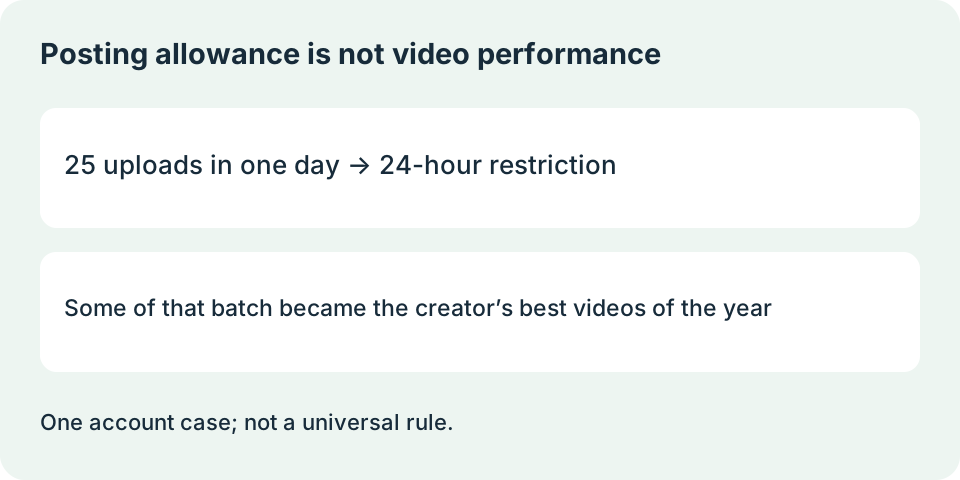
Twenty-five uploads, then a 24-hour restriction
In a March account case, 25 Trial Reels in one day were followed by a 24-hour loss of access. Several videos in that batch nevertheless became that account's highest-performing videos of the year.
The same account later tested different ideas and published more than ten trials a day without a loss of reach. The temporary publishing restriction and strong video performance were both part of that experience. It does not match a universal five-upload ceiling or a universal 30-day restriction.
Three spoken hooks, with no two-versus-three result
One workflow filmed a video, recorded three spoken openings, cut three versions, and uploaded them as trials. Whether to reduce that batch to two remained an unanswered question.
There is no two-versus-three performance comparison attached to that account. The three-version workflow is concrete; a winning batch size is not established.
Five to eight a day, then a change on May 1
In another account, five to eight daily trials during the first half of the year accompanied daily views from more than 200,000 to millions. That pattern stopped on May 1, followed by a reduction in posting volume. That sequence does not establish that the earlier posting count caused the later decline.
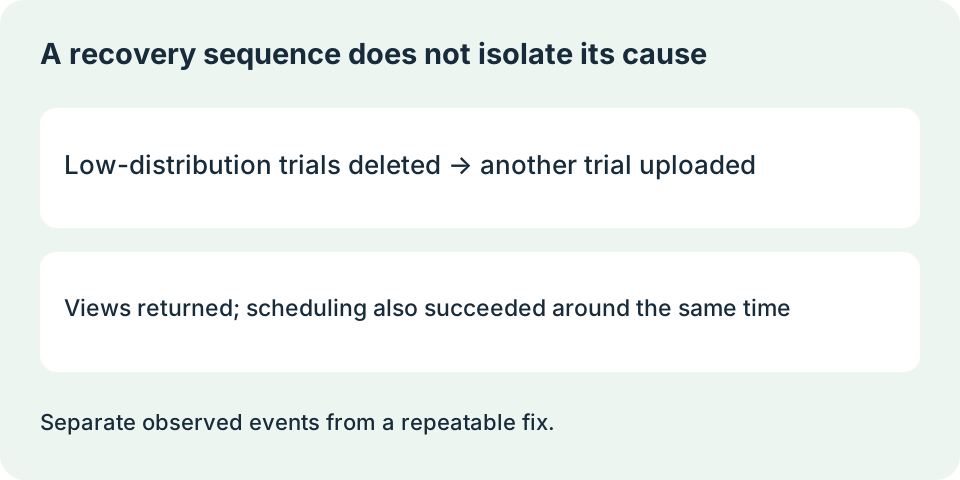
In a separate account, low-distribution trials were deleted and another trial was uploaded; views immediately returned. Another trial was also successfully scheduled around the same time. Deletion, another upload, and scheduling all appear in that sequence; it does not isolate deletion as the cause of recovery.